Mollie Welch and the Norman Hartnell archive: beads from a royal workroom
In January 1937 an embroiderer from Sydenham walked into Norman Hartnell's couture house in Mayfair for her first day of work. Her name was Mollie Welch, and she began a notebook that same month. Nearly ninety years later, her beads and sequins sit in my atelier.
This is her story: who Mollie was, what she stitched, and what the surviving materials actually are.

Norman Hartnell and Bruton Street
Norman Hartnell opened his own business in 1923 at 10 Bruton Street, in Mayfair. In 1934 he moved across the road to a larger town house, number 26, with workrooms at the back on Bruton Mews. He stayed there until 1979, and a blue plaque now marks the building.
Behind the elegant salon at the front, those workrooms were where the real labour happened. Cutters, fitters and seamstresses turned Hartnell's sketches into gowns, and embroiderers covered them in beads, sequins and pearls. Hartnell himself could not sew. His dresses depended entirely on the hands of people like Mollie.

Mollie Welch, tambour embroiderer
Mollie worked with a tambour hook, the same tool I teach today under its French name, the Lunéville hook. With it an embroiderer can lay a line of sequins or beads quickly and evenly, which is why couture houses relied on it for heavily worked evening dresses.
She was a valued member of Hartnell's team in the 1930s, the 1950s and the 1960s. Her clients, through the house, included Queen Elizabeth (later the Queen Mother), Queen Elizabeth II, Princess Margaret and the Duchess of Gloucester.
What makes her story so precious is her notebooks. In each one she recorded the date, the client's model and the time she spent on every garment. It is the working diary of a couture embroiderer, written in her own hand, something that very rarely survives. Most workroom staff left no record at all.

Coronation year, 1937
Mollie arrived at Bruton Street in the year of a coronation. George VI and Queen Elizabeth were crowned in May 1937. The Queen stayed loyal to the court dressmaker Handley Seymour for her coronation gown, but she ordered the dresses for her maids of honour from Hartnell.
Mollie's notebooks are said to record work on a bodice for Queen Elizabeth for the Coronation. I find it remarkable that within months of her first day she was already stitching for the Queen.

A white wardrobe for Paris
The following year brought the royal state visit to France. The King showed Hartnell the Winterhalter portraits in the Royal Collection and suggested the Queen adopt the romantic style favoured by Queen Victoria. Hartnell revived the crinoline for grand evening occasions.
Then the Queen's mother, the Countess of Strathmore, died shortly before the visit. Court mourning meant the planned colours could not be worn, and the workrooms remade the whole wardrobe in white. Mollie's notebooks list outfits for the royal visit to France. White on white, every bead and sequin had to catch the light on its own, which is a beautiful challenge for any embroiderer.
Hartnell received his Royal Warrant as Dressmaker to Queen Elizabeth in 1940.

Coronation year, 1953
In 1952 George VI died, and his daughter asked Hartnell to design her coronation gown. It had a sweetheart neckline and a full, heavy silk skirt, embroidered with the floral emblems of the United Kingdom and the Commonwealth countries. Hartnell's assistant Ian Thomas helped sketch the many versions before the final design was chosen.
Mollie's notebooks record coronation dresses for Queen Elizabeth II and for Princess Margaret. I cannot tell you exactly which section of which gown passed under her hook, and I would rather not guess. What I can say is that she was in the Hartnell workrooms in both coronation years, sixteen years apart, stitching for the royal family.

When she eventually left the studio, Hartnell wrote to thank her.

What the surviving beads and sequins are
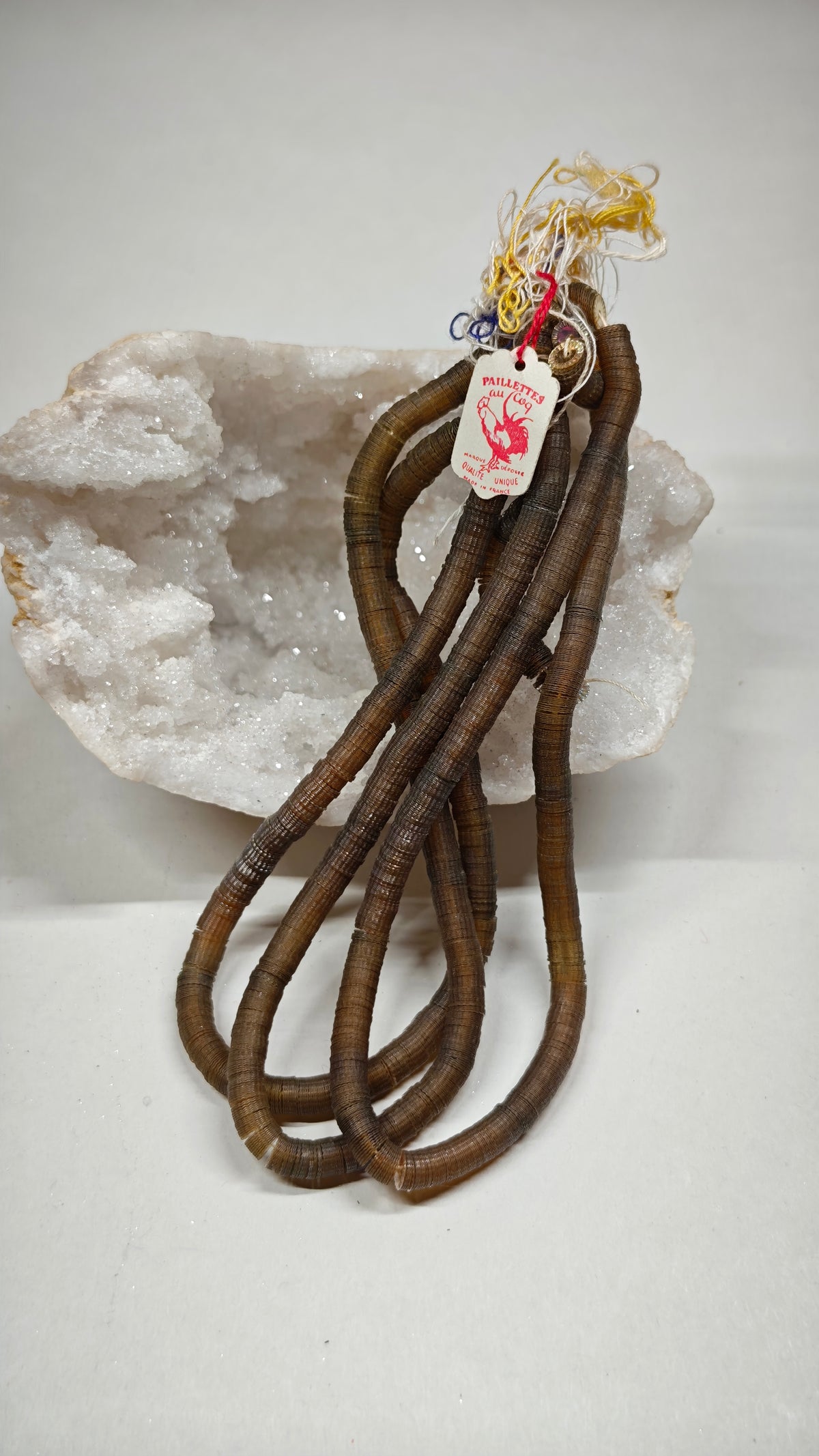
Mollie also kept a large quantity of mid-twentieth-century beads and sequins. They are working materials from a couture workroom, not decorative souvenirs, and that is what I love about them. Here is what they include:
- Bead threads. Glass beads still strung on their original threads, usually 50 cm long and gathered into hanks, mostly of twelve threads, with some vintage hanks of ten. Bugles (small glass tubes) are among my favourites.
- Sequins on thread. Sequins strung for the tambour hook, ready to be laid in overlapping lines, in finishes and colours that are no longer made.
- Tagged factory hanks. A few hanks still wear their makers' tags: a Belgian hank with a black peacock, and a British set labelled WESPA Spangles. Together they show how sequins were made and traded between Belgium and Great Britain.
- Metal sequins. Genuine metal sequins sit beside the plastic and acetate ones.

You will notice that the patina on these materials is different from modern stock. The colours have a softness and depth that comes from the old formulas and from decades of quiet storage. Once they are gone, there is no way to make more.

Why I share them
I could keep everything in a drawer, and I do keep a reserve for my own work. But beads made for Hartnell's workroom were meant to be stitched. Every time one of these threads goes into a new piece of embroidery, Mollie's craft carries on a little further.
Which royal gown would you have most liked to see in progress on her frame?
Explore the archive
You can browse the beads and sequins from Mollie's collection in the Norman Hartnell Archive, and the rarest tagged hanks in Collector's Pieces. If you would like to learn the tambour technique Mollie used, start with the Atelier Box: it brings you the Lunéville hook, a frame and step by step lessons, so you can stitch with materials like these yourself.