The peacock hank: sparkle from pre-war Belgium

Some things arrive with their story already attached. This one arrived with a tag.
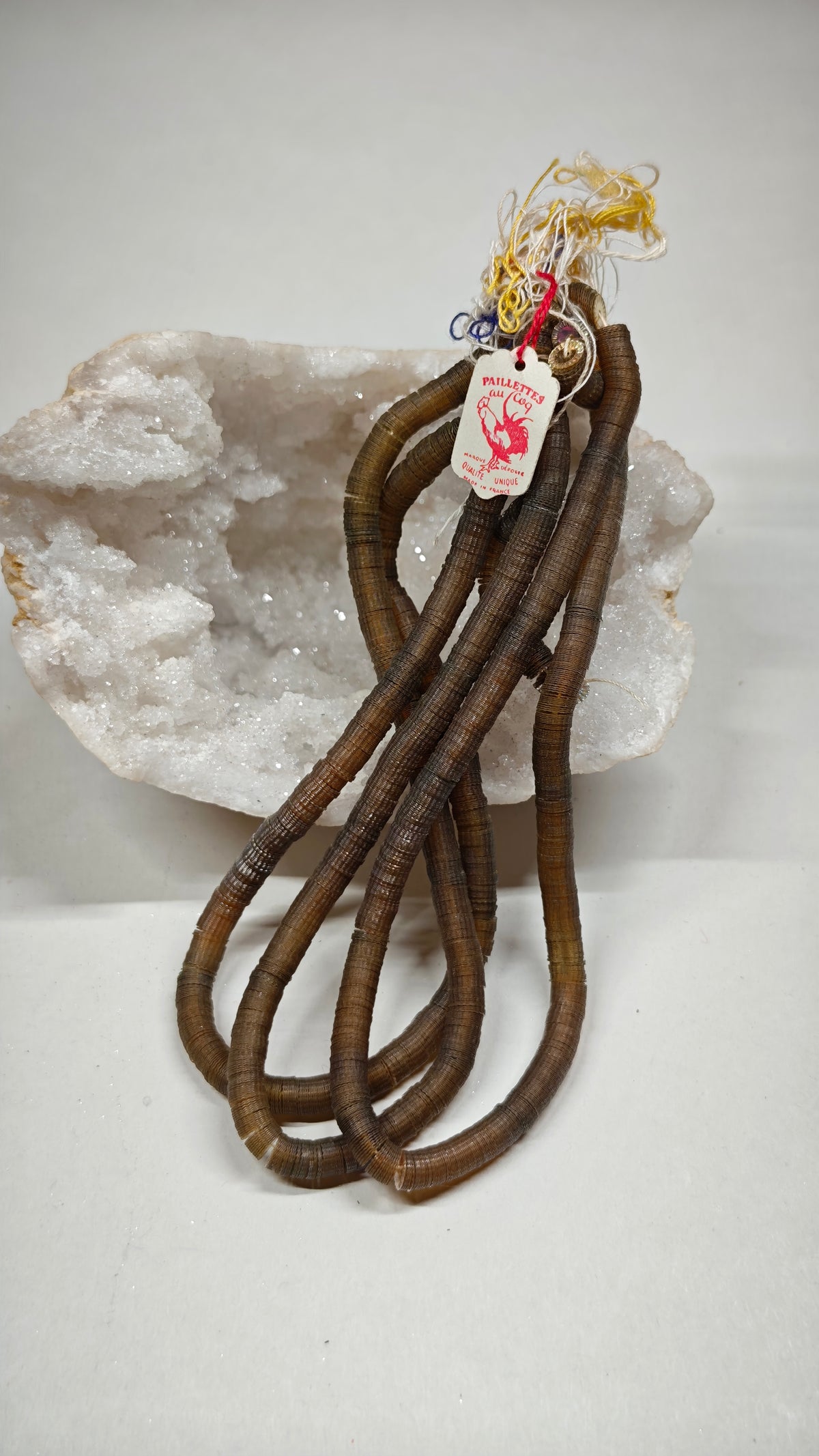
It is a hank of black sequins, still tied with salmon-pink string and closed with a little brass seal. Nobody has ever cut the thread. Hanging from the knot is an oval of beige card: a black peacock printed on one side and, on the other, three words in English. Made in Belgium.
The sequins are cellulose acetate, one of the first plastics, made from cotton and wood. They have a soft, deep shine that modern sequins rarely manage. Everything about the hank points to the years before the Second World War. To understand where it came from, we have to travel to Belgium around 1900, a small country that was having a golden moment.
Belgium in its Belle Époque

Picture Brussels at the turn of the century. New boulevards, glass arcades, cafés full of light. Victor Horta was building his Art Nouveau houses with staircases that curl like tendrils. In 1910 the city hosted a World Exhibition, and visitors came from everywhere to see what Belgium could make.
And Belgium could make a great deal. It was the first country on the Continent to industrialise, with coal, steel, railways and textile mills. It also had one of the busiest ports in Europe at Antwerp, where ships left daily for London, New York and beyond. A small country with very busy hands.
A nation of lace makers

Long before factories, Belgium was famous for something much finer. For centuries its women made lace by hand: Brussels lace, Mechelen lace, the bobbin lace of Bruges. Girls learned at lace schools and at their mothers' knees, working tiny stitches in linen thread for hours at a time.
Those hands were ready for sparkle. When Paris fashion began asking for beads and sequins, Belgian workshops took up the tambour hook, the same tool I teach with, known today as the Lunéville hook. The town of Lier, near Antwerp, became a centre for beaded and sequinned embroidery and stayed one until the 1960s. Paris couture houses sent embroidery orders to Belgian workshops, and the work came back fine and beautifully even.
Sequins stamped in Brussels

Belgium did not only stitch sequins. It made them. Old copies of the Brussels newspaper Le Soir still carry the proof. In February 1901 a small notice mentions a Fabrique de Paillettes, a sequin factory, at 43 rue du Damier. In December 1906 a firm called H. Ronfosse et Cie, of rue Rossini in Anderlecht, advertised for workers to join its sequin production.
They are only a few lines of print, but they let us imagine the scene: presses stamping tiny discs by the thousand, women stringing them on thread, hanks tied and tagged and packed into boxes for shops and embroidery workshops.
The sequin maker from Lunéville

One name links all of these places. Edmond Dannhauser was born in 1868 in Lunéville, the little town in Lorraine where tambour embroidery on tulle was perfected in the early 1800s, and where embroiderers first added beads and sequins with the hook.
He went to Paris and opened a sequin factory in 1906, and in 1914 he patented a machine for stringing sequins. That sounds like a small thing until you hold a hank like mine: every disc is threaded in perfect order so an embroiderer can lay them quickly, one after another, with the hook.
By 1921 his company had offices in Lunéville, Paris and Brussels, with links to Lier and to the bead makers of Bohemia. He also helped found an embroidery school in Lunéville, which the couturière Madeleine Vionnet supported. Did his firm make my peacock hank? I honestly do not know. But he shows how closely Lunéville, Paris and Brussels were stitched together.
The Twenties and Thirties: a sparkling time

Then came the 1920s, and sequins were everywhere. Dresses for dancing were covered from neckline to hem, so they swung and flashed under the lights. Metal sequins were heavy, so makers were delighted by the new plastics. Gelatine came first, in the Twenties, and then in the Thirties cellulose acetate, light enough for a dress to move freely and available in rich, even colours.
Belgian makers were part of this boom, and my black acetate hank belongs to its second chapter, the Thirties.
Why the tag speaks English

A Belgian tag printed in English is a clue. Since 1887, goods sold in Britain had to show where they were made, which is why so many things carry the words "Made in" followed by a country. So this hank was probably made for export, shipped from Antwerp across the North Sea to a London wholesaler, and sold to British dressmakers and embroiderers.
Which wholesaler? I have a suspect. Faudels, a London haberdashery firm, used a peacock as its trade mark. It is a theory, not a proof, and I am still searching old trade papers for the answer.
Still whole, nearly a century later

Hanks like this were made to be used. Embroiderers cut the thread, stitched the sequins and threw the tags away, as they should. That is why so few survive, and why you will hardly find one online.
Mine came from the workroom collection of Mollie Welch, a tambour embroiderer who worked for Norman Hartnell in London. With it came a small group of these Belgian hanks, each still on its original thread, some still wearing the peacock.
When I hold one, I think of the lace makers who became beaders, the presses in Brussels and the ships leaving Antwerp. A whole bright era, tied up with salmon-pink string.
So, whose peacock was it? If you have seen this tag before, in a grandmother's sewing box or a museum drawer, I would love to hear from you.
See the hanks for yourself
The tagged Belgian hanks and other rare pieces are in Collector's Pieces, and the beads and sequins from the same workroom are in the Norman Hartnell Archive. If you would like to stitch sequins the way Belgian and Lunéville embroiderers did, the Atelier Box is where to begin: the hook, the frame and the lessons to learn Lunéville embroidery from the very first stitch.