Jeanne Paquin: the queen of couture nobody remembers

Ask anyone to name a great woman of French fashion and you will hear Chanel, perhaps Lanvin or Schiaparelli. Hardly anyone says Paquin. Yet long before Chanel opened her first hat shop, Jeanne Paquin was one of the most famous couturières in the world, dressing queens, actresses and the richest women of two continents.
A girl from Saint-Denis

She was born Jeanne Beckers in 1869, just outside Paris, in Saint-Denis, a town of factories and canals rather than salons. As a young girl she went to work as a dressmaker at the house of Rouff, on the boulevard Haussmann. She learned everything there, from cutting to fitting, and rose to become première, the woman in charge of the whole workroom.
That is a long way to climb for a girl from Saint-Denis. The premières of Paris were famous for their skill and their nerve: they turned a sketch into a gown and kept dozens of seamstresses working to the minute.
Number 3, rue de la Paix

In 1891 Jeanne married Isidore Paquin, a businessman whose family had a shop of their own, and together they opened the house of Paquin at 3 rue de la Paix, the most elegant street in Paris. A few doors along stood the House of Worth, the most powerful name in couture.
It was a perfect partnership. Isidore ran the business; Jeanne designed. Her dresses were soft, feminine and full of colour, layered with tulle, edged with fur, and covered in embroidery, beads and lace. Clients loved that she was a woman designing for women, who understood how a dress should feel as well as how it should look.
The Parisienne of 1900

In 1900 Paris held a World Exhibition, and fifty million visitors came to see it. Jeanne Paquin was chosen to lead its fashion section, an extraordinary honour for a woman of thirty-one.
Visitors entered through a monumental gate crowned by a huge statue of a woman called La Parisienne. She was the spirit of Paris itself, and she was dressed by Paquin. Inside, the house showed its gowns in glass cases, and crowds pressed against them as if they were jewels.
An empire of dresses

Success came quickly. Paquin opened a house in London on Dover Street in Mayfair, and then went further: New York, Buenos Aires, Madrid. At its height the house employed more than two thousand people, from cutters and seamstresses to furriers, embroiderers and the young women who modelled the dresses.
Paquin understood that a dress sells best when people see it moving. She sent her models to the races and to the opera dressed in her latest designs, so fashionable Paris saw the new season before it ever reached the salon.
Alone at the top

In 1907 Isidore died suddenly. Jeanne was thirty-eight. She took over the business as well as the designs. From then on she dressed mostly in black and white, and she kept the house growing.
In 1913 France awarded her the Légion d'honneur, the first woman couturier to receive it. During the First World War she became president of the Chambre Syndicale de la Couture, the body that speaks for the whole Paris couture industry. No woman had led it before.
Artists in the workroom

Paquin loved working with artists. Léon Bakst, the designer of the Ballets Russes, created dresses for her house, full of the colour and drama of the stage. The illustrators of the Gazette du Bon Ton, such as George Barbier, drew her gowns as tiny works of art. Fashion and art had never been so close.
A house full of embroidery

Look closely at a Paquin gown in a museum and you will see why it belongs in a story about embroidery. Bodices are scattered with beads and sequins, tulle is worked with tiny stitches, and lace is laid over silk in rich layers. Embroidery was not an extra; it was part of the design.
One of the most famous names in couture embroidery began with her. In 1904 a young Parisian called René Bégué won a Paquin competition for embroidery designers and was sent to the London house. Years later, as Rébé, he would embroider for Dior and Balenciaga.
Walking away

In 1920, at fifty-one and at the very top, Jeanne Paquin retired. Her house carried on without her, guided by new designers. She died in 1936. In 1954 Paquin joined with the House of Worth, its old neighbour from the rue de la Paix, and two years later both names closed for good.
That may be why we forgot her. She left at the height of her fame, she wrote no memoir, and when her house closed nothing carried her name forward the way Chanel No. 5 carried Chanel's.
Her era in my hands
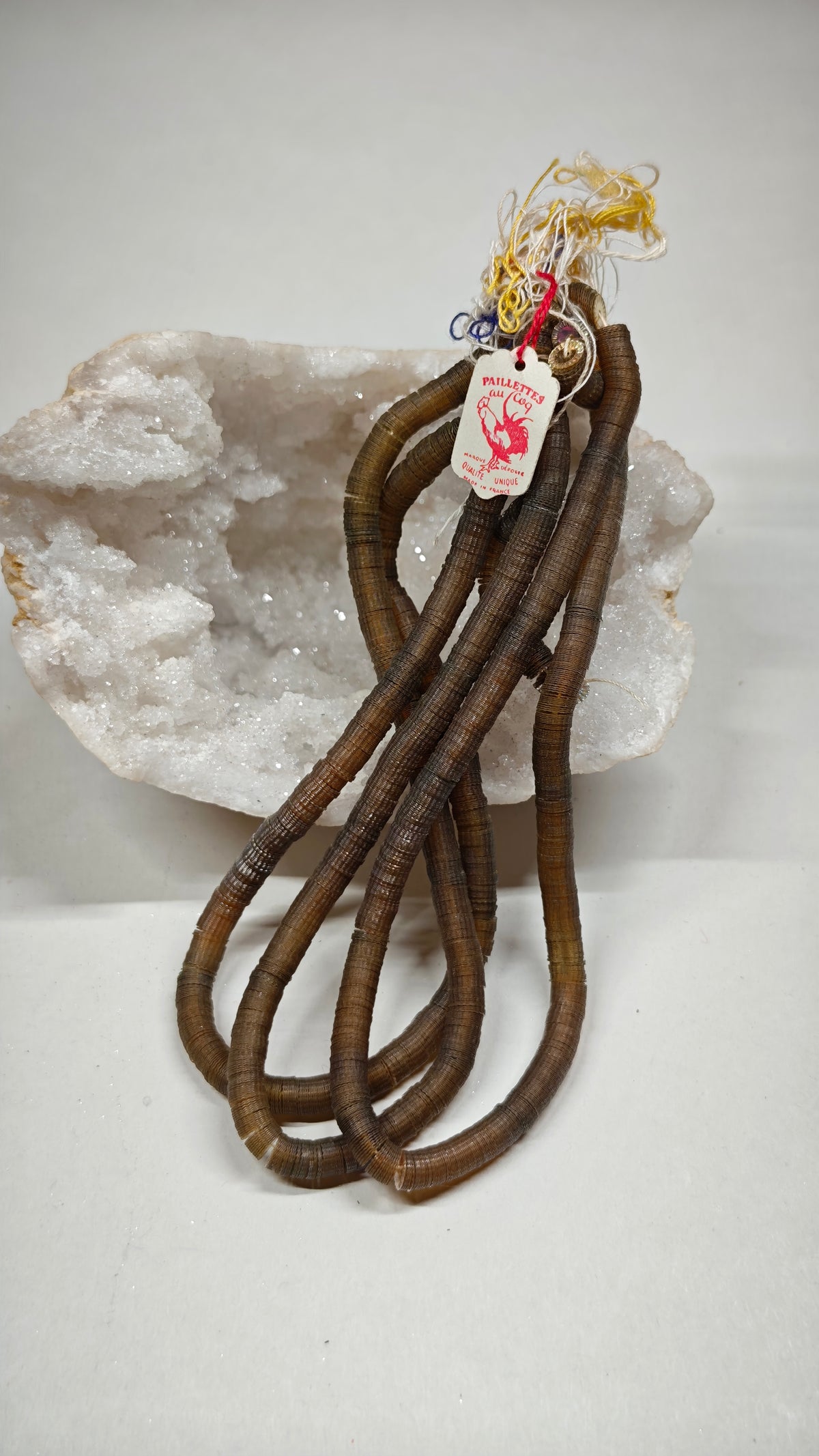
When I stitch with beads and sequins of the early twentieth century, I think of the workrooms that served houses like Paquin: rows of embroiderers at their frames, hooks flashing, every bead laid by hand. The vintage beads in the Norman Hartnell Archive and Collector's Pieces still carry a little of that sparkle. If you would like to learn the Lunéville hook, the tool of couture embroiderers since her day, the Atelier Box is the place to start.
So now you know her name. Will you remember it?