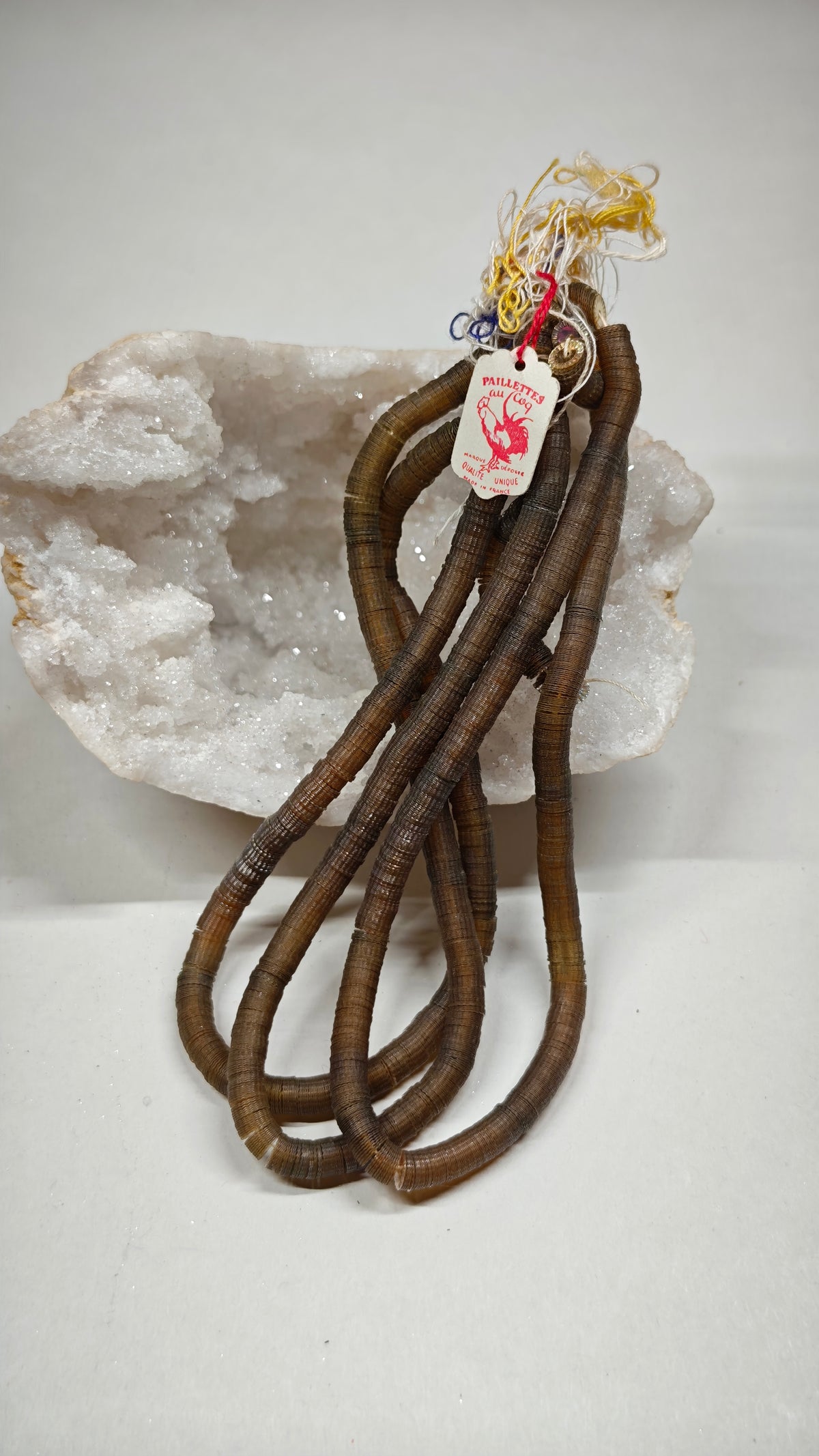
The story of sequins: a tiny disc, 3,000 years old
Every sequin I lift onto my hook has a very long family tree. Before it was a tiny plastic disc on a thread, it was a scrap of gold, a coin, a mark of rank. Its story runs from a pharaoh's tomb to a chemistry laboratory in Ohio, and it is far stranger than you might expect.
Sewn-on gold
The idea is ancient and very simple: if you want a garment to catch the light, attach small pieces of metal to it. In Egypt, thin gold discs and beads were stitched onto the clothes of the powerful, and some of the most famous examples were found among the treasures of Tutankhamun. They were jewellery and wealth that you wore, not decoration in the modern sense. Three thousand years later, the opening of his tomb in 1922 caused a sensation, and the shimmering dresses of the 1920s owe a little of their glamour to it.

A word that began as money
Our word sequin also has a golden past. The Arabic sikka was the die used to strike coins, and from it Venice named its mint the Zecca. The gold ducat minted there became the zecchino, which the French turned into sequin. For centuries women across the Mediterranean and the Middle East sewed real coins onto headdresses and dresses, wearing their savings where everyone could see them. In French workrooms, though, the little disc is still a paillette.

When metal sequins began
The sequin as we know it, a small pierced disc made only to sparkle, belongs to Europe from the late Middle Ages onwards. In England it was called a spangle. By the 1500s and 1600s, embroiderers at the Tudor and Stuart courts were scattering tiny spangles of real silver and silver gilt over linen caps, coifs, jackets and gloves, and strict laws on dress kept gold and silver for those of high rank.

Early spangles were made by hand: a fine metal wire was wound into tiny rings, each ring was hammered flat, and the gap where the ends met became the hole for the needle. Later they were punched from thin sheets of metal. Through the 1700s, metal sequins of silver, gold-coloured alloys and copper glittered on men's waistcoats and court suits as much as on women's gowns, and they remained the sequin of choice until the early twentieth century.

The hook changes everything
For centuries every spangle was stitched on with a needle, one at a time. The great change came from Lunéville, in Lorraine, where embroiderers worked fine chain stitch with a tiny hook on a tambour frame. In the 1860s Louis-Bonnechaux Ferry found a way to add beads and sequins with that same hook, threading them below the fabric and laying one with each stitch. A line of sequins could now be laid many times faster, and Paris couture took notice. It is the technique I teach, and it still feels like a small miracle each time.
The roaring twenties
By the 1920s, sparkle was everywhere. Short, straight evening dresses were covered from neckline to hem, and they moved and flashed with every step of the Charleston. All that metal was heavy, though, so makers began to search for something lighter.

From cotton fields and forests
The first answer was gelatine, light and beautifully coloured but hopeless in the rain: damp air and warm dancing bodies could soften it until the sequins melted away. The next came from photography. Cellulose acetate, the clear film used in cameras, is made from plant fibre: cotton and wood pulp, treated until they turn into a transparent sheet. It could be coated, coloured and punched into discs, so these early sequins began life in a cotton field or a forest. They glowed like glass, and like glass they could crack.

Made in Great Britain
Around the same time, Britain developed tough new plastics such as Perspex, famous as the clear canopy over a fighter pilot's head. British spangle makers such as WeSpa put strong plastics to use, and one of my own treasures is a WeSpa hank still wearing its little tag, Made in Great Britain.

A lucky mistake
The sequin most of us know today began with an accident. In 1926 Waldo Semon, a chemist at B.F. Goodrich in Akron, Ohio, was trying to bond rubber to metal and produced vinyl instead. Soft, waterproof and cheap, it went on to make records, raincoats and, after the war, sequins that anyone could afford.

Why I love the old ones
Modern sequins are practical and wonderful, but the vintage ones carry their era in them: softer colours, unusual cuts, real metal and finishes no factory makes any more. Stitching them gives them a second life. You can find them in the Norman Hartnell Archive and Collector's Pieces, and if you would like to learn the hook that changed everything, begin with the Atelier Box.
Which chapter of the story surprised you most?